
GENERATOR CARE BLOG POST:

Is Your Facility's Generator Up to Pennsylvania Code?

Why Generator Code Compliance Matters in Pennsylvania

From nor’easters to summer storms and aging grid infrastructure, Pennsylvania facilities depend on backup power. For hospitals, senior living, schools, data and telecom sites, manufacturing and commercial buildings, standby generators are part of how a building stays safe and operational, and they are part of how a building is permitted and inspected.

The Code Framework in Pennsylvania

Pennsylvania uses a statewide Uniform Construction Code (UCC) administered by the Department of Labor & Industry:

  • The UCC adopts most chapters of the 2018 International Building Code (including Chapter 27, Electrical, which covers emergency and standby power), along with other 2018 I-Codes, with Pennsylvania exclusions and modifications. The 2018 codes took effect February 14, 2022.
  • Electrical work follows the National Electrical Code (NFPA 70) as referenced by the adopted I-Codes
  • Fire and life-safety requirements for existing buildings and operations come from local fire codes and, for some facility types, state agencies such as the Department of Health
  • Engine emissions and fuel storage may involve the Department of Environmental Protection (DEP) and local air-quality programs

Enforcement is typically by the local municipality or a certified third-party agency, so permit steps, inspections and local amendments can differ from one township or borough to the next.

Emergency vs. Standby Power

Under the adopted IBC provisions, emergency power serves life-safety loads and must restore power within 10 seconds; standby power serves other required or optional loads and must restore within 60 seconds. Both are designed to run at least 2 hours without refueling unless another section says otherwise, and stationary generators must be listed to UL 2200 and installed per NFPA 70, NFPA 110 and NFPA 111. Elevators, emergency responder radio systems and some high-rise features can trigger standby power requirements of their own.

Testing and Maintenance Expectations

Once a system is in service, the burden shifts to maintenance. NFPA 110 expects regular exercising and inspection with written records, and for many sites that includes periodic load bank testing. Healthcare, senior living and other regulated occupancies often have additional testing and documentation requirements from their own licensing agencies.

What Pennsylvania Facilities Should Plan For

  • Permits and inspections: confirm early who enforces the UCC in your municipality and what drawings or electrical inspections are required.
  • Cold weather: block heaters, battery condition and fuel quality matter more when temperatures drop; plan for them in your maintenance schedule.
  • Fuel quality: diesel stored for long periods can degrade; testing and fuel polishing help keep it start-ready.
  • Multi-site portfolios: a consistent testing and documentation routine across sites simplifies audits. See our multi-site management service.

How MGS Helps Keep Pennsylvania Generators Ready

Managed Generator Services is a family-owned company with factory-trained, certified technicians, serving 12 states from New Jersey to Florida. For facilities in Pennsylvania, we can help with:

  • Preventative maintenance programs matched to your site and your manufacturer’s recommendations
  • Load bank testing and documented test records
  • Remote monitoring for early warning and run-time records
  • NFPA 110 compliance support, including testing schedules and record-keeping
  • Service on all major generator brands
  • Installation coordination with your electrician and local code official

Have questions about your Pennsylvania site? Contact our team or see our Pennsylvania service page.

Important Note

This article is a high-level overview and is not legal advice or a substitute for a site-specific code analysis. Actual requirements depend on your occupancy classification, the size and type of your generator and its loads, fuel type and storage, emissions rules, and local amendments and interpretations. Always confirm requirements with your local authority having jurisdiction (AHJ).
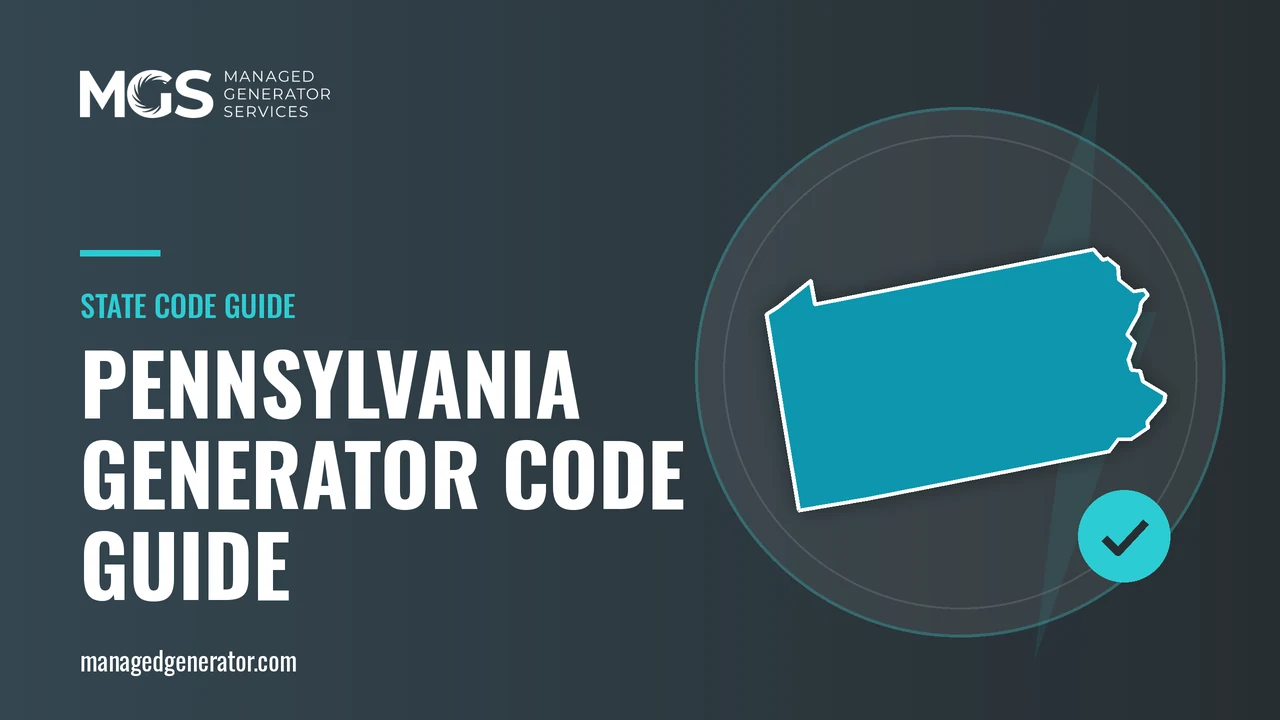
Pennsylvania generator code guide - Managed Generator Services
Standby and emergency generators in Pennsylvania fall under the state’s Uniform Construction Code and local enforcement. Here is a plain-English overview.
August 18, 2026
Recent Blog Posts:
Cover image for: Load Bank Testing: Step-by-Step Procedure Your Technician Follows
Load Bank Testing: Step-by-Step Procedure Your Technician Follows
What happens during a generator load bank test, from pre-test inspection and load steps to cool-down and the final report, and how to prepare your site.
READ THE FULL POST
November 23, 2026
Cover image for: 5 Signs Your Emergency Generator Is Failing Its Load Bank Test
5 Signs Your Emergency Generator Is Failing Its Load Bank Test
Five warning signs your emergency generator is failing a load bank test, from unsteady voltage to overheating and shutdowns, and what to do next.
READ THE FULL POST
November 23, 2026
Cover image for: Understanding Test Results: How to Read Your Load Bank Report
Understanding Test Results: How to Read Your Load Bank Report
A plain-language guide to your generator load bank report: equipment details, load steps, voltage, frequency, temperatures and what the findings mean.
READ THE FULL POST
November 23, 2026